

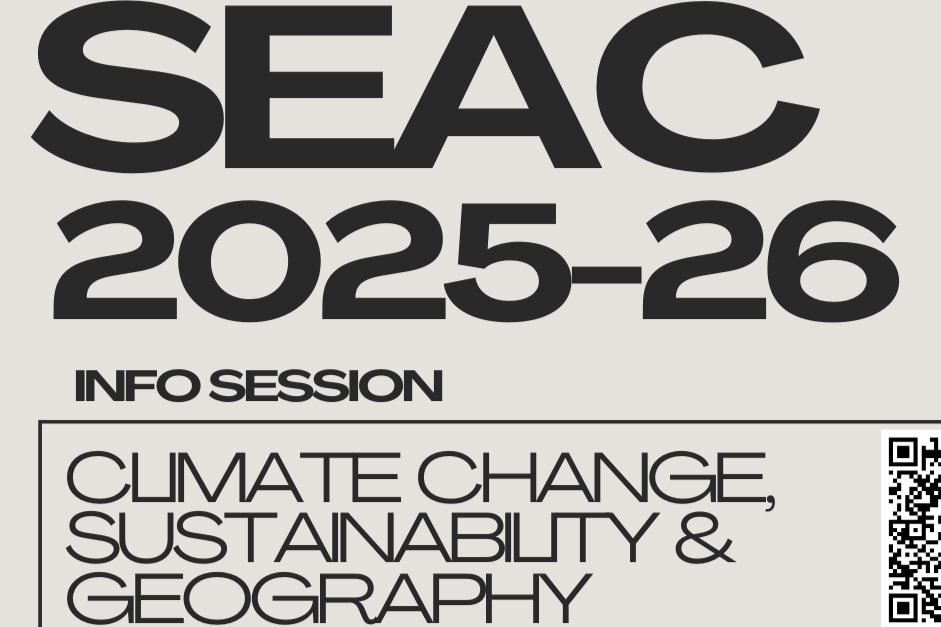
SEAC Fall 2025 Course: Climate Change, Sustainability, and Geography
This course, Climate Change, Sustainability, and Geography, examines environmental, social and economic dimensions of sustainability in Southeast Asia. Participants will learn about these dimensions with a close examination of their contributing factors, challenges, adaptation and mitigation strategies and practices from a multi-disciplinary perspective.
The course is open to all students in CUNY and SUNY, grad and undergrad, regardless of discipline.
Your co-professors will be Vida Vanchan (SUNY Buffalo State University), Michitake Aso (SUNY Albany), and Peter Marcotullio (CUNY Hunter College).
Key details (subject to final confirmation!):
1-credit (with a 0-credit audit option)
One 1.5-hour online-synchronous meeting/week for 10 weeks
Enrollment via registering for an independent study with one of the lead faculty or a professor at your home institution (but you will then join the class)
No prerequisites
FAQ:
Q: Do I need to be a part of the January field school to be a part of the course?
A: No, though there will be some overlap in members of the class and those who are part of the January 2026 field school, you are welcome to join the class without being a part of the field school.
Q: How do I join the class?
A: Fill out the course interest form, linked here
Have other questions? Watch our recorded info session below and check out the information session slides here.
SEAC Spring 2025 Course: Southeast Asian Identities in Popular Culture & Literature
SEAC 2025, Southeast Asian Identities in Popular Culture and Literature, examines how Southeast Asian identities are made “legible” across different cultural media. Participants will explore issues of representation and translation in contexts of change, such as colonialism/post-colonialism, diaspora and migration, settler colonialism, indigeneity, and globalization, and ask questions about who is included and excluded in processes of representation, translation, and globalization.
The course is open to all students in CUNY and SUNY, grad and undergrad, regardless of discipline.
Your co-professors will be EK Tan (Stony Brook University), Martina Nguyen (Baruch College/CUNY), and Lauren Meeker (SUNY New Paltz).
Key details (subject to final confirmation):
1-credit (with a 0-credit audit option)
One 2-hour online-synchronous meeting/week
Enrollment via registering for an independent study (but you will then join the class)
No prerequisites
FAQ:
Q: Do I need to be a part of the summer field school to be a part of the course?
A: No, though there will be some overlap in members of the class and those who are part of the Summer 2025 field school, you are welcome to join the class without being a part of the field school.
Q: How do I join the class?
A: Fill out the course interest form, linked below
Have other questions? Watch our recorded information session and check out the information session slides below.

SEAC Spring 2024 Course: Sites and Spaces of Mobilization in Southeast Asia
Take our Spring 2024 course—open to any CUNY or SUNY student (grad and undergrad, regardless of discipline). Your co-instructors will be Benjamin Tausig (Stony Brook University) and Nerve Macaspac (Queens College/Graduate Center).
Key details:
1-credit (with a 0-credit audit option)
One 2-hour online-synchronous meeting/week (most likely Fridays)
Enrollment via registering for an independent study (but you will then join the class)
No prerequisites
Learn about:
Southeast Asia as a site of mobilization
Researching mobilization, including issues of representation and ethics (and reflections on the January 2024 field school, for those who attended)
Intersections between scholarship and activism
Different disciplinary perspectives on mobilization: what might an ethnomusicologist, a geographer, an anthropologist, a political scientist, etc. see or address?
What you will do in class:
Hear excellent guest lectures
Read interesting, non-arduous texts
Engage actively in discussions
Document and reflect upon what you have learned (in writing and/or multimedia form)
To register, contact Benjamin Tausig or Nerve Macaspac.
Application Deadline: January 16, 2024